


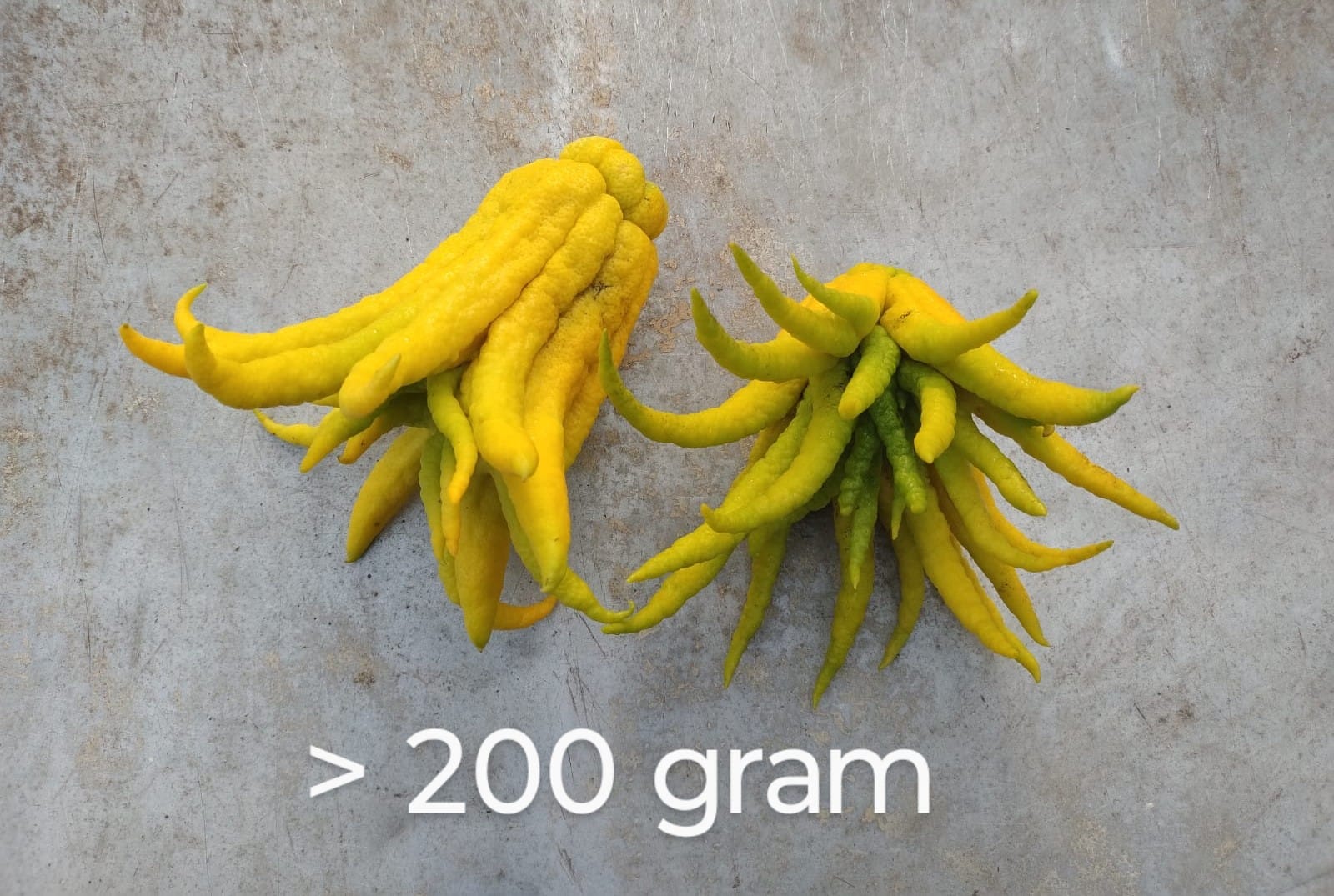



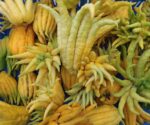


Buddha's hand (finger lemon) from the Netherlands - 1 piece (> 200 grams)
€ 24,42 incl. VAT
Rare and beautifully distinctive citrus. Contains no juice, but a thick rind with intense, fresh-floral, sweet and sour aroma. Great for candies, marmalades and cocktails or as a substitute for lemon zest/peel. Also a fragrant ornament and New Year's gift.
Uitverkocht
This product is currently sold out.
No worries! Enter your email, and we'll let you know as soon as it's back in stock.
Description
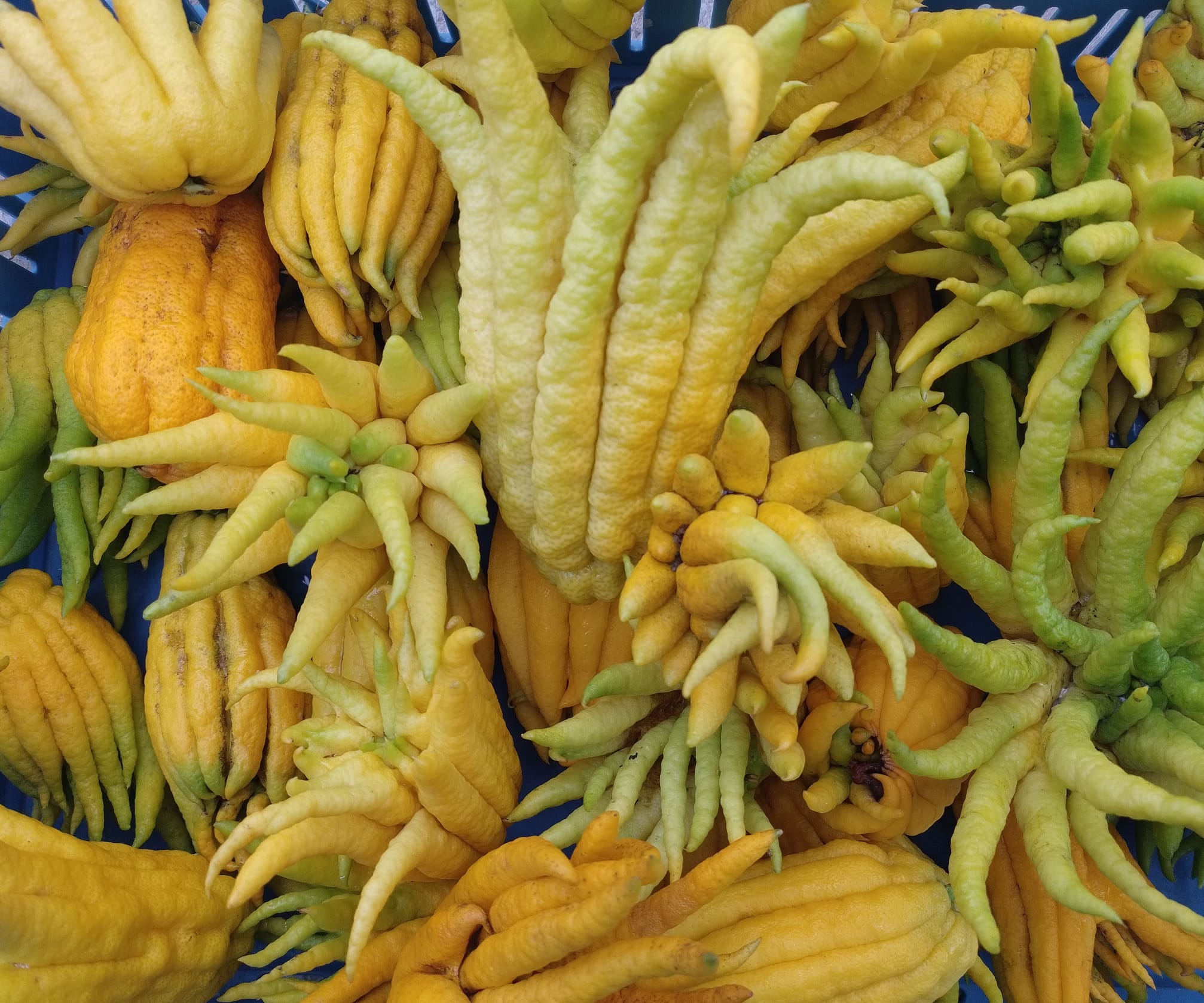
The Buddha's Hand (Citrus medica var. sarcodactylis) is a striking and rare citrus fruit also called “finger lemon” or fingered citron is called. That name refers to its characteristic appearance: the fruit consists of several elongated “fingers” reminiscent of the hand gestures of Buddha statues (mudras). The plant is a mutant variety of the citron, one of the primordial parents of modern citrus species. The shape of this variety resembles an open hand, with the individual “fingers” slightly apart.
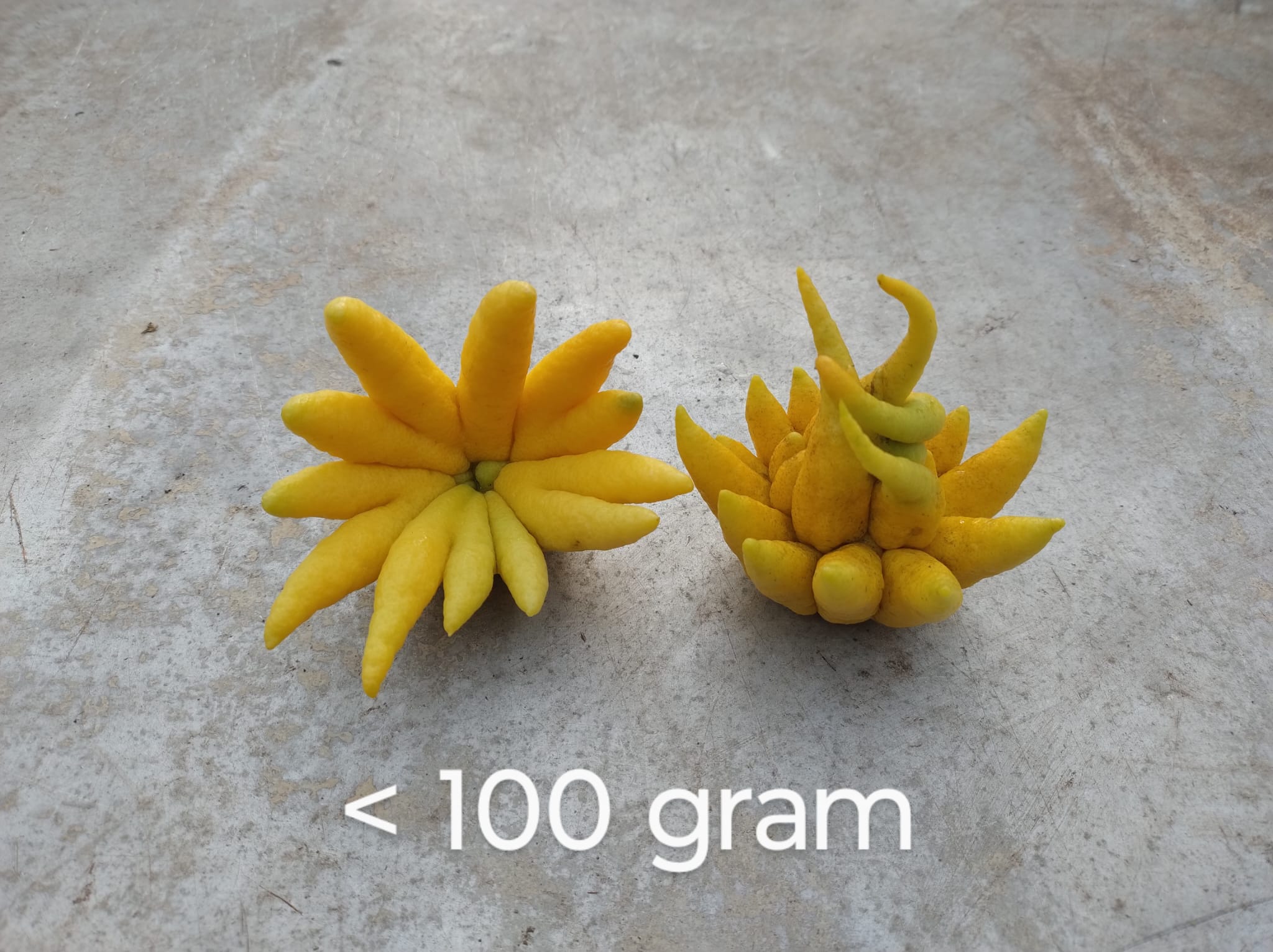
This buddha's hand comes from our own greenhouses in the Westland, so extra special! Besides this size, we have two other variants in the range: < 100 grams, and 100-200 grams.
Unlike most citrus fruits, Buddha's Hand contains virtually no juice or pulp. The fruit consists mainly of a thick, fragrant yellow skin and a white inner layer (albedo). Some varieties may contain some sour pulp, but generally its use revolves mainly around the peel, which is known for its distinct aroma. Many people in Asia use it purely as a fragrant ornament to, for example, make the house, dishes or clothes smell wonderful (and it looks pretty too!). Because of that great aroma and spectacular look, the fruit has also become increasingly popular in the kitchen, even among Western chefs.
Taste and aroma
The aroma of Buddha's Hand is intense but refined. It is distinctly citrusy, but less sharp than lemon and has a sweet, floral, almost perfume-like tone reminiscent of lemon blossom and light vanilla. A classic lemon smells fresher and more acidic, often with a bitter edge in the peel, while the Buddha's Hand emits a warmer, sweeter and more complex fragrance.
The taste is also milder than that of a regular lemon. Because there is hardly any juice present, you taste mainly the peel and the white interior. The latter is soft and surprisingly neutral; it has a little bitterness, but not as strong as often found in lemons. The yellow peel tastes fresh and aromatic, similar to lemon but softer and more floral, without the sharp acidity. Because of this, the fruit is mainly used to add fragrance and aroma without making something immediately very sour; for example, grated, in sugars, syrups, jams, or in dishes where a subtle citrus note is desired.
Application
The skin of Buddha's Hand can be used in almost all recipes in which lemon peel or zest is requested. Because the flavor is powerful, you usually don't need much. The peel fits both in sweet preparations - desserts, baked goods, jams - as in savory dishes such as fish, tofu, salads, sauces and dressings.
Two popular uses are candied peels and marmalade. In the chaffing the peel is slowly “cooked” in sugar, making it deliciously sweet and perfect as a snack or garnish. For marmalade the peel is often combined with another citrus fruit, simplifying the process. You can reduce any bitterness in the peel or white part by briefly triple-straining it. blanching.
Also in cocktails the fragrance comes into its own, both as a flavoring and a decoration.
In addition, the Buddha's Hand is used in syrups, liquors (such as variations on limoncello) and to sugars to aromatize.
Growth and origin
There are several theories about the origin and distribution of the fruit. The fruit is believed to be native to India, and it is thought to have been introduced to Japan about four centuries ago (probably via China). The fruit has been appreciated for centuries in both China and Japan. Nowadays, the fruit is mainly grown in China, India and Japan, but now also closer to home: in our Westland.
The fruit is naturally rare. Buddha's Hand likes conditions similar to other citrus, but is even more sensitive to cold and extreme conditions. It likes a warm and mild climate, is very sensitive to frost, needs lots of sunlight, likes dry feet, but needs regular watering. She is also susceptible to root rot and pests. Moreover, it has a relatively slow growth rate. Hence, this rare fruit is therefore relatively expensive.
Culture and tradition
In Buddhist traditions, the Buddha's Hand is often used as an offering (for example, on home altars or in temples). This is common in countries such as India, Thailand and Myanmar, China and Japan. Many people (especially in China and Japan) also use her purely as a fragrant and aesthetic ornament to, for example, make the house, dishes or clothes smell wonderful.
In China, the fruit is known as fóshǒu (佛手) and also symbolizes happiness, prosperity, wealth and long life. This makes it a popular gift around Chinese New Year. But also in Japan, where it is known as bushukan (仏手柑), for example, there is a belief that a bushukan tree in the garden brings prosperity “from generation to generation.” Because the fruits fan outward, their shape is seen as a sign of growth and expansion, which fits well with New Year rituals.
In Japan, the Buddha's Hand has a rich history in art and rituals: in flower arrangements, tea ceremonies (think the candied version) and as a motif in paintings, sculptures and ceramics. Around the turn of the year, the fruit sometimes appears at Japanese florists as a decorative good luck charm. In New Year decorations, the fruit sometimes fulfills a similar symbolic role as the daidai (橙)(bitter orange), which traditionally sits atop the kagami mochi (鏡餅) is placed to wish prosperity for future generations.
Save
The shelf life is relatively good, although the aroma diminishes as soon as the fruit begins to dry out. Anyone who wants to cook with the fruit is therefore best to do so in good time. It is best to keep the fruit in the vegetable drawer of the refrigerator. For decorative (and/or perfuming) use, it is best to keep the fruit cool and out of direct sunlight, preferably in a place with natural airflow; it dries out too quickly under a fan.
You may also like…
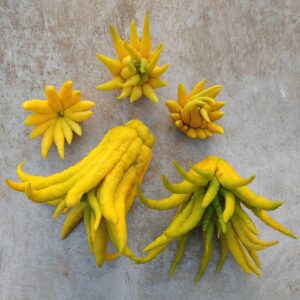
Buddha's hand (finger lemon) from the Netherlands - 1 piece (< 100 grams)
Buddha's hand (finger lemon) from the Netherlands - 1 piece (100-200 grams)