



Blog
All about matcha

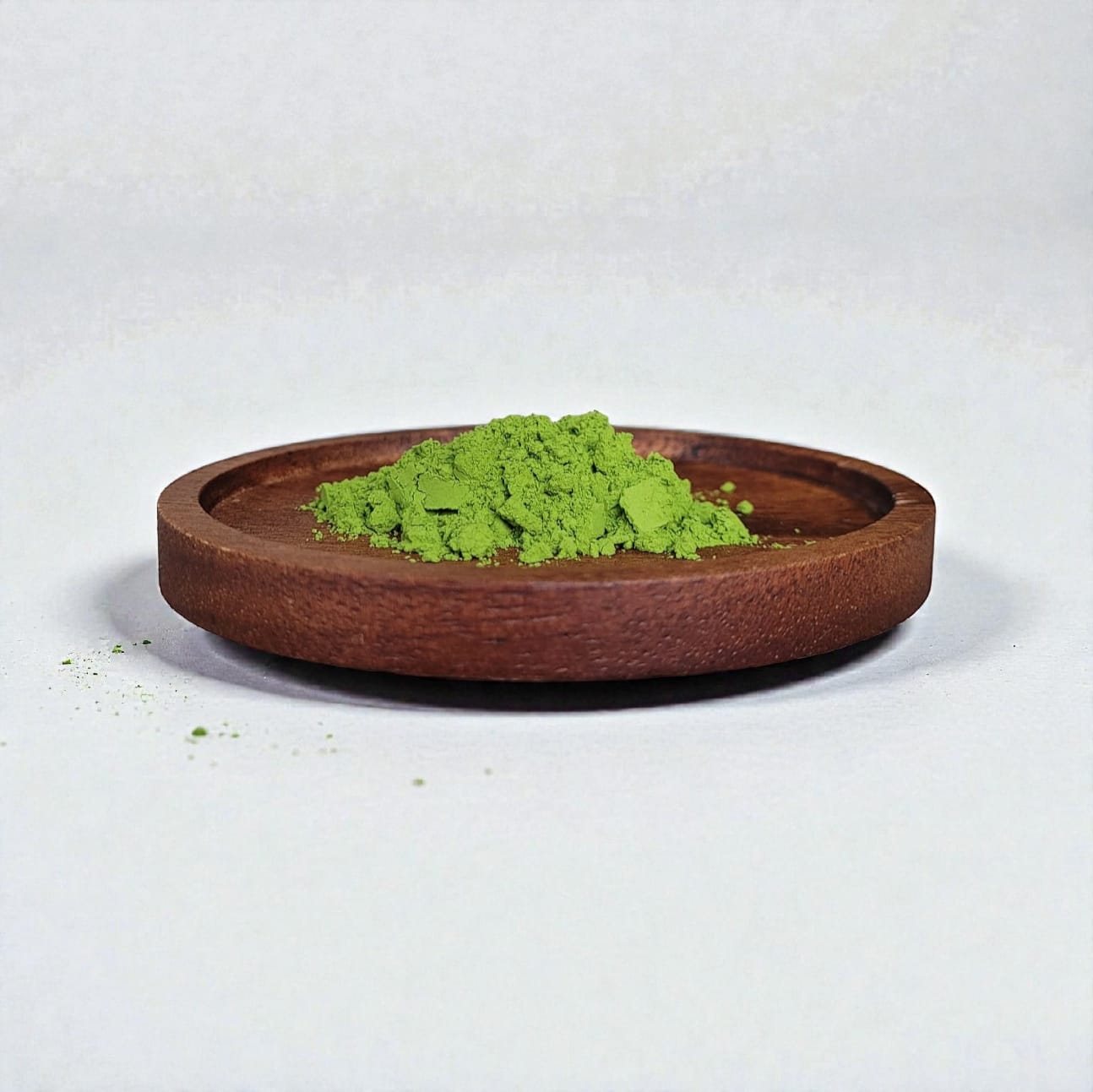
Matcha (抹茶): the green tea powder that has become hugely popular in recent years, especially in latte form. Originally (and traditionally) matcha has been drunk in Japan for centuries as “pure tea,” meaning without milk and other things in it. Matcha is much more than just a trend. There is a long, rich (cultural) history behind this beautiful green powder. We'd like to invite you to dive into that a bit.
Cultivation
Matcha comes from the plant Camellia sinensis, a species shrubs which grow in rows on matcha farms. They grow in mild climates (as in Japan) with plenty of water, rain and well-drained soil. The tea plants from which the tencha leaves come are shaded for a few weeks before harvest; a traditional shading technique.
Japanese tea is green because the tea leaves are steamed immediately after picking. This process destroys the enzyme that would otherwise cause the leaves to ferment and turn black. After harvesting and steaming, the leaves are called tencha (碾茶).
In Japan, there are two main forms of tea: leaf tea and powdered tea (matcha). For matcha, the leaves are dried flat and later ground into a fine, light green powder. Matcha is the drink of the Japanese tea ceremony and is prepared by the serving, not by the pot.
Traditional & cultural
Green tea (ocha), along with sake, is the national drink of Japan. Tea became known in Japan as early as around the eighth century through China. In that early period, tea was considered primarily a medicine and a stimulant for the upper classes of society. For the Japanese, tea is much more than a mere beverage: it is strongly associated with ritual, Zen and daily life. Over the centuries, many rules and forms of etiquette have developed that are now deeply rooted in Japanese culture.
Matcha is the tea of the traditional Japanese tea ceremony, known as chanoyu (茶の湯). Traditionally, matcha consists of nothing but water and the tea powder whisked into it. Prior to a Japanese tea ceremony, a sweet is often eaten, such as daifuku: mochi with red bean paste (anko), to compliment the somewhat dry and bitter taste of the tea. In addition, sweets can also be served with tea. Many Japanese sweets are specifically designed to be eaten with green tea.
Application
Matcha is not only drunk but also used in various dishes. In Japan, for example, it has long been incorporated into a variation of the recipe for sweet potato and chestnut puree (satsuma-imo kinton) (a popular New Year's Eve dish) or mixed with a syrup and poured over a pyramid of shaved ice cast.
Nowadays, matcha is additionally drunk around the world, including in Japan (especially in major cities) in the form of a latte. Another popular application of it is adding a fruit puree, such as strawberry or mango, or tapioca balls in a bubble-tea (boba). There are also numerous (modern and/or Western) culinary applications; think matcha tiramisu, cakes, cookies, mochi, etc.
Matcha is additionally often drunk as an alternative to coffee because (thanks to its caffeine content) it can provide a nice boost.
Taste
Matcha, despite its popularity, is not immediately easy for everyone to drink. Preparing it takes some practice and proper techniques, and the amount of powder (and any additional ingredients) also requires some searching for the balance that works for you. Matcha naturally has a mild sweetness, slight bitterness, umami and a fresh, almost grassy aroma. While subtle, this can take some getting used to for some people - just as many people have to get used to coffee. So give yourself time to taste and experiment; that's how matcha can become a great experience.
There are many different matchas on the market, all of which taste slightly different. This is due, for example, to quality, origin and processing. Some are a bit softer, others a bit stronger. The umami, sweetness, bitterness, grassiness, etc. can also differ slightly. In general, it is nice to have a stronger matcha for a latte, because the milk (especially in a hot drink) can dilute the taste.
Despite the fact that generally better quality matcha also tastes better, further differences in powders are also subjective, of course.
Don't be fooled by those who say that matcha is not supposed to be bitter at all. In fact, matcha has a distinctive slight bitterness that has made it popular for centuries. It should not be too bitter, especially when accompanied by a “fishy” taste or smell. In that case, the quality of the powder may be poor, but it can also be due to too much powder or too hot water.
Quality
Finding your way through all the different matchas on the market can be tricky. To find a good quality matcha, you can pay attention to the following things.
The pick
A good quality matcha has leaves from the first pick: ichibancha (一番茶). These are the youngest, softest leaves from the spring that are high in chlorophyll and amino acids. This makes the taste and color of the tea better.
Processing
A good quality matcha is ideally steamed briefly and carefully; this prevents oxidation, preserving its bright green color and fresh flavor.
Additionally, removing veins and stems from the leaves ensures that only the soft leaf portions are used, making for finer, softer matcha of better quality.
Grinding also plays an important role. Slow grinding with stone (traditional) mills prevents heating, which preserves aroma and nutrients. Fast industrial grinding creates heat and a less complex and bitter taste. An industrial machine certainly does not have to indicate poor quality. Good quality fine grinders can grind powder very well and consistently and are faster than stone mills. If such a fine grinder uses a ‘low temperature method,’ it prevents “burning” of flavors and preserves color and nutrients. Moreover, if a stone mill is of poor quality and proper techniques are not used, this may actually result in poor matcha as well. Finally, a mill or grinder alone cannot determine the quality; it is obviously also down to all the other factors such as the quality of the leaves themselves.
Color
Good quality matcha has a bright green and fresh color. If your matcha looks very yellow-brown, this is usually a sign of lower quality.
Texture
A good quality matcha has a (very) fine and silky texture. You can easily whisk such a powder into creamy and even foam, so you won't experience grittiness when drinking. (Just be sure to ideally always sift your matcha before use to avoid lumps in your drink.) Lower quality matcha is coarser, grainy and less homogeneous, making it harder to whip up.
You can test the quality of your matcha texture by smearing a small mound of matcha with your finger on a sheet of paper: good quality matcha spreads out smoothly and evenly with little to no grain. It leaves a thin, even layer, as if it were almost paint. In addition, it feels silky smooth, almost like talcum powder.
Origin
The main region of matcha cultivation is Uji (Kyoto); this is considered where the best quality comes from. Other well-known regions are Nishio and Shizuoka. Japan generally has a lot of knowledge, tradition and strict rules for matcha cultivation. And even though there is some general difference between the regions, it is mainly about the difference in producer.
There is also a difference in how a ‘batch’ of tea leaves is constructed. This can (ideally) come from the same farmer or be a blend from multiple farms. For better quality, you do want the blend to come from the same region. A blend does not necessarily mean lower quality, but it does mean more affordable matcha.
Grades
Often you come across terms like ‘culinary grade., ‘ceremonial grade’ or ‘latte grade. It is important to note, however, that these terms are not traditional or official, but are primarily aimed at marketing. ’Culinary grade‘ indicates that the matcha is intended for cooking and baking (e.g., in cookies). This is often a slightly lower quality matcha, making it less tasty to drink pure. Sometimes the matcha has sugar or milk powder added to it and the texture and taste is coarser.
‘Ceremonial grade’ is therefore not an official traditional term used by the Japanese, but it is used to indicate that the quality of matcha is at such a high level that it can be drunk as a pure tea (without milk, etc.). Latte grade‘ indicates that it is of a slightly lower quality, suitable for use in a latte, but less delicious when drunk pure.
Nowadays there are also many ‘’fake matcha’’ on the market. This may look like Japanese matcha at first glance, but it is a different powder made from different (tea) leaves. Make sure it is 100% Japanese tencha (碾茶).
Save
Always store matcha airtight, dark and cool. Oxygen, light and heat cause matcha to fade quickly and reduce its flavor. After opening, matcha is tastiest within 4-8 weeks, but that does not mean it is necessarily no longer good or delicious after that. When resealing the bag, carefully squeeze out all the air (don't let the powder fly out!) and make sure the seal is really tight. Moisture should absolutely not come in contact with the powder, so make sure your spoon is thoroughly dry before use.
The THT of matcha is always quite short, mainly because the quality can deteriorate slowly, not because the product spoils quickly. Often (unopened) matcha remains good for months. The expiration date is usually no longer than one year after the first picking; this is to ensure taste and quality.
Over time, color, flavor and aroma may diminish, but this does not necessarily mean the product is spoiled. Always smell, look and taste: if everything seems normal, there is usually nothing wrong and no loss of quality. Also, matcha is intentionally sold in small quantities (such as 30 g), so you'll probably finish it well before the THT.
Recipe and supplies
Curious about how to make your own matcha and what you need to do so? In our other post you will find recipes for a classic matcha and various matcha lattes, including video!