



Blog
All about Nori

History & production
The use of Nori dates back many centuries. It is difficult to determine exactly from when, but given that Nori was mentioned in a tax levy law in a law from 702, the use is at least 1,300 years old. It was during the Edo period (1603-1867) that the Japanese began producing Nori sheets as we know them today. For stable production of high-quality Nori, innovation in cultivation methods continues to this day.
Today, most Nori is farmed. It is grown in calm seas in the regions of Kyushu, the Seto Island Sea, Tokai, Chiba and Miyagi. The seeds are planted in nets in late summer. Nori grown on the farm is harvested from autumn to spring.
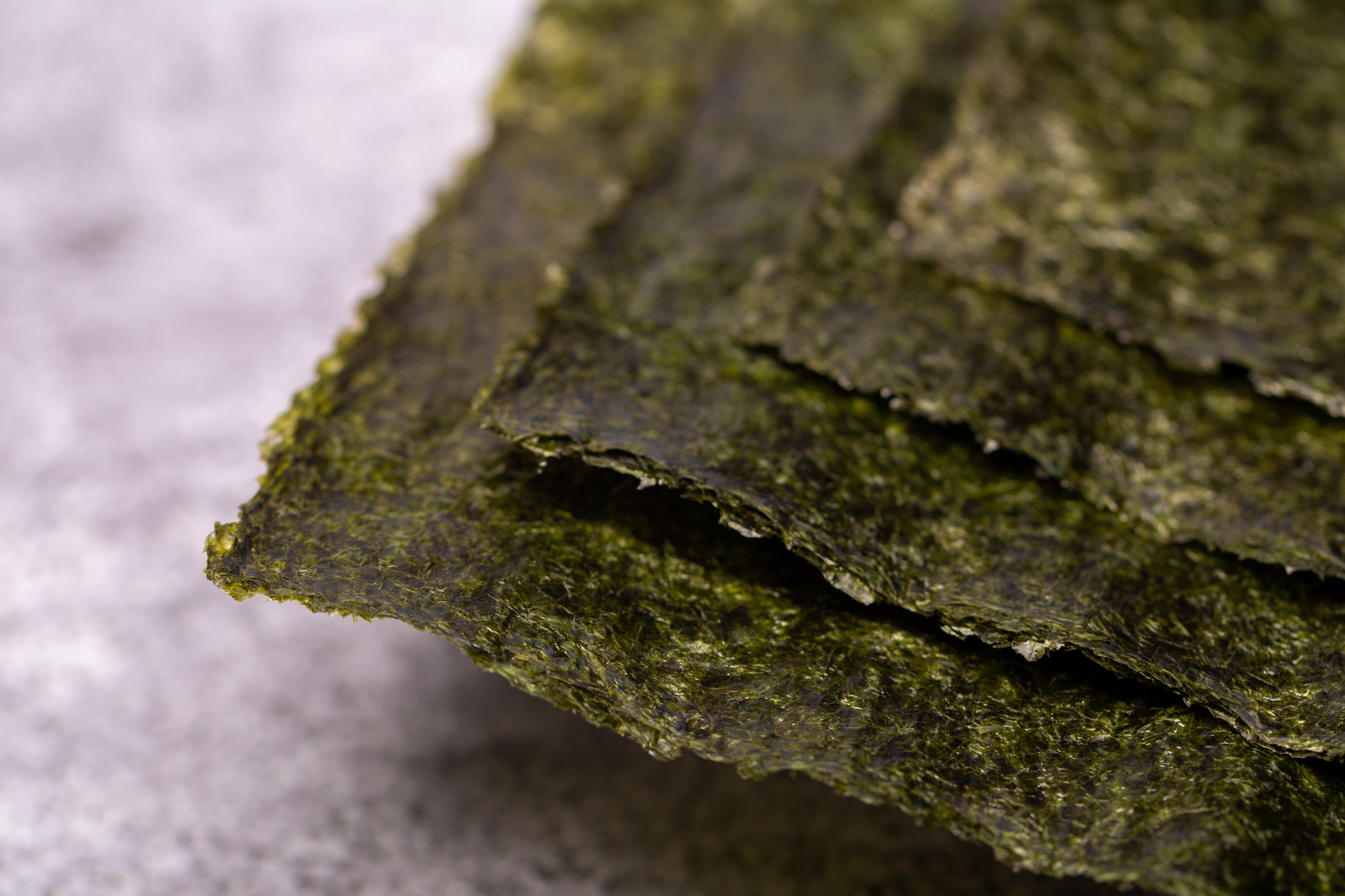
To produce dried nori seaweed, fishermen shred fresh nori and then mix it with fresh water. This mix is fed into a frame the size of the nori sheet. The frames move along the production line while being heated at a temperature of no more than 50°C. At the end of the process, most of the nori is toasted to produce a crisp shiny sheet of nori. Roasted nori is suitable for sushi.
Toasted (yaki nori) and unroasted
Most nori sheets are toasted but you can also buy unroasted nori sheets. They contain a higher amount of moisture and have no toasted flavor. The more water the nori contains, the less crispy the nori is. Roasting helps get rid of excess moisture. Unroasted nori is excellent for salads, rice dishes and stir-fries. It has a stronger flavor and a tougher, thicker texture that goes well in some dishes but is not suitable for preparing sushi.
Should the need arise, toasted nori can be re-roasted for a crispier and lighter texture. This is especially useful if you have kept nori opened for a while. If nori is not packaged properly airtight, it quickly attracts moisture and thus becomes tougher.
Most nori is sold as whole sheets (full sheet) 21x19cm. However, half sheets or even smaller are also available for smaller or thinner sushi rolls or other applications such as rice balls.
Quality
The best nori has a dark color, uniform thickness and no holes. When rolled, it does not break and is crisp at the first bite. In your mouth, it melts on your tongue and it it a nice umami flavor.
Low-quality Nori can be tasteless and tough and may have a mixture of other side tastes. It is often brown or light green.
Production areas
Ariake Sea
Saga Bay in the Ariake Sea is famous for growing nori. The region produces 20% of Japan's nori production, even up to 40% if Fukuoka, Kumamoto and Nagasaki are included. Ariake Sea is the largest and most famous seaweed-producing area in Japan. Saga Bay in the Ariake Sea is surrounded by mountains. Their rivers bring rich minerals to the ocean water. It is known for the high quality of its seaweed. The fresh Nori from this region has a wonderful salty taste, subtle and not overpowering. It is the harmony of gentle neighboring mountain waters with salty sea currents that gives the famous nori from Saga its unique earthy tones. It has a long, pleasant, fresh aftertaste.
Seto Inland Sea
The Seto inland sea is the 2the largest seaweed producing area in Japan. The Seto inner seaweed tends to be somewhat tougher. It does not soften easily when in contact with moisture, so it is suitable for sushi rolls that need to be stored for a while.
Aichi
Aichi is less renowned as a seaweed producing area than Ariake or Setouchi, because the production volume is not as large, yet the quality of the seaweed from Aichi is of high. The nori from this area has a good taste and color and is well suited for Sushi, rice balls, topping for soba etc.
Miyagi
Because Miyagi is the northernmost seaweed producing area, the first seaweed of the year comes from Miyagi. Roasted seaweed from this area is highly sought after.
Chiba
Chiba used to be famous as an Edo-mae (ancient capital of Japan) seaweed. The nori from this area is very good.
Great source of nutrition
Nori is called “soybean of the sea” and “vegetable of the sea” in Japan. Nori is rich in various nutrients; minerals, vitamins, dietary fiber, etc.
Protein
40% of nori is made from an egg white and this is similar to soybeans. The amount of protein in 1 sheet of nori is equivalent to 1/5 egg. Moreover, protein from nori contains all the essential amino acids.
Vitamins
Nori contains many vitamins, especially vitamins A, B1, B2, C; 10-100 times more than those of ordinary vegetables. 2 sheets of nori contains the full daily recommended amount of vitamin A, B1, B2.
Minerals
Nori contains various minerals; potassium, calcium, magnesium, iron, zinc, etc. In 1 sheet of nori there is the full daily recommended amount of iron. Good for preventing anemia.
Dietary fiber
Like all vegetables, nori is also rich in fiber. Moreover, fiber from nori is softer than that of vegetables, so it is easy on our digestion.
Ideas for using nori
Nori sheets can be sliced, finely chopped or ground for many uses other than just the traditional sushi roll.
- Use it cut into small strips as a garnish. You could reheat it in a pan or overn with some oil and spices for extra flavor.
- Make your own furikake. Shred the sheets into small pieces and mix it with herbs or seeds as a flavoring over salad, rice or sandwiches.
- Roasted Nori Dip; shred the nori, add mayonnaise, Greek yogurt, chives, rice vinegar, white miso and some salt and pepper.
- Onigiri (rice ball); take some Koshihikari (preferred) rice, mix it cooked with your favorite furikake, make a nice “ball,” cut the nori sheet to the right size and place a the onigiri in the sheet of nori.